Introduction
Healthcare organizations operate under some of the most demanding compliance requirements in any industry. Between HIPAA mandates, customer due diligence questionnaires, and an ever-expanding threat landscape, proving your security posture has moved from a nice-to-have to a business imperative. Two frameworks consistently rise to the top of compliance conversations: HITRUST and SOC 2.
Both offer legitimate paths to demonstrating security maturity, but they are fundamentally different in their approach, scope, cost, and recognition within the healthcare market. Choosing the wrong one can mean spending six figures on a certification your customers do not actually require, or conversely, investing in a report that fails to satisfy the compliance teams at major health systems.
This guide breaks down the differences between HITRUST and SOC 2 in concrete, practical terms. We will cover what each framework actually is, how they compare on cost and timeline, when each one makes sense, and how to decide which path (or combination of paths) fits your organization. If you are also evaluating ISO 27001 alongside SOC 2, see our companion post on ISO 27001 vs SOC 2.
What Is HITRUST?
The HITRUST Common Security Framework (CSF) is a comprehensive, prescriptive security framework designed specifically for organizations that handle sensitive healthcare data. Unlike many other frameworks, HITRUST is both a control framework and a certification program. The current version is HITRUST CSF v11.8.0, released in May 2026 and mandatory for all new e1 and i1 assessments.
The HITRUST CSF Framework
HITRUST consolidates requirements from over 40 authoritative sources into a single, unified framework. These sources include HIPAA, NIST SP 800-53, ISO 27001, PCI DSS, COBIT, and state-specific privacy regulations. Rather than forcing organizations to map controls across dozens of separate standards, HITRUST provides a single set of controls that satisfies multiple regulatory obligations simultaneously.
The framework is organized around 14 control categories that cover everything from access control and audit logging to physical security and business continuity. What distinguishes HITRUST from more flexible frameworks is its prescriptive nature: HITRUST tells you not just what to implement, but specifically how to implement it, with detailed control requirements that scale based on your organization’s risk profile.
HITRUST Assessment Types
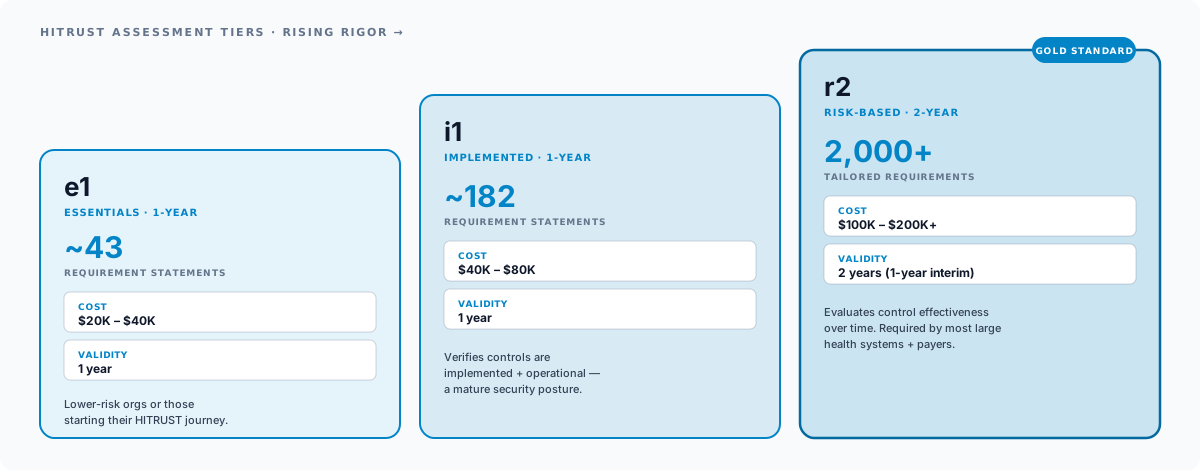
HITRUST offers three assessment levels, each designed for different organizational needs and risk tolerances:
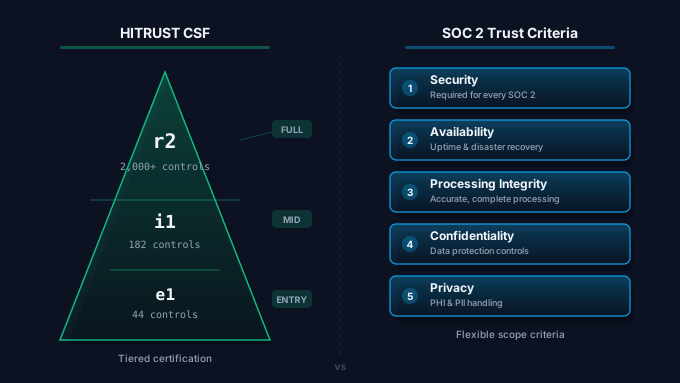
e1 (Essentials, 1-year): The entry-level assessment covers 43 core requirement statements (under HITRUST CSF v11.8) focused on the most critical cybersecurity practices. The e1 is designed for lower-risk organizations or those beginning their HITRUST journey. It evaluates foundational controls like access management, encryption, and incident response at a basic level. Validity is one year.
i1 (Implemented, 1-year): The mid-tier assessment evaluates approximately 182 requirement statements and is designed for organizations that need to demonstrate a more mature security posture. The i1 focuses on verifying that controls are implemented and operational, rather than just designed. It covers a broader range of security domains and provides a higher level of assurance than the e1. Validity is one year.
r2 (Risk-based, 2-year): The most comprehensive assessment. It starts from the i1 182-statement baseline and scales up to 2,000+ tailored requirements depending on the organization’s risk factors. The r2 includes a detailed risk analysis and evaluates both the implementation and effectiveness of controls over time. It carries a two-year validity period and is widely considered the gold standard for healthcare security certification. The r2 is what most large health systems and payers require from their business associates.
The HITRUST Assessment Process
The assessment process follows a structured path regardless of which level you pursue. First, your organization completes a readiness assessment to identify gaps. Then you remediate those gaps, implement required controls, and document evidence. An authorized HITRUST External Assessor conducts the formal assessment, reviews evidence, and submits findings to HITRUST for quality review. HITRUST itself performs a final quality assurance review before issuing (or denying) certification.
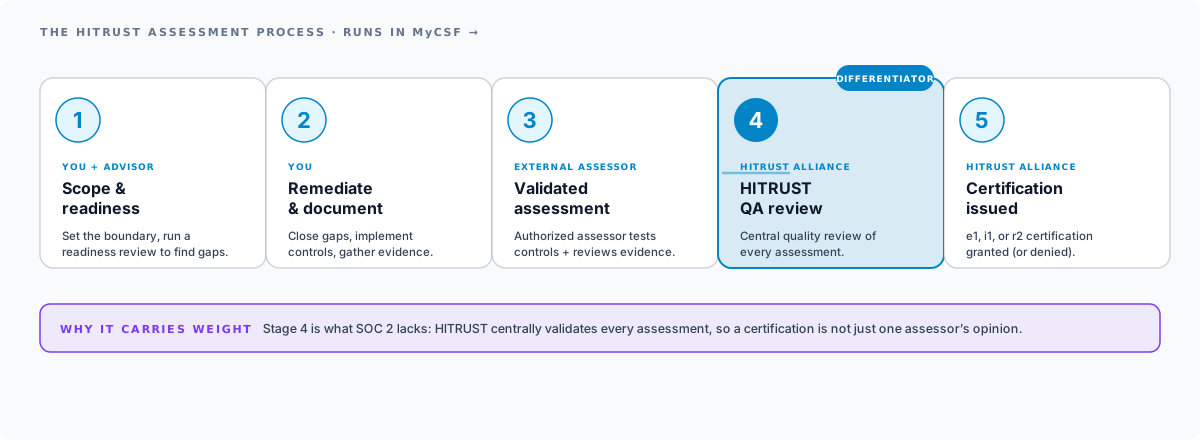
This multi-layered review process is one reason HITRUST certifications carry significant weight in the market. It is not just your assessor’s opinion; HITRUST centrally validates every assessment.
What Is SOC 2?
SOC 2 (System and Organization Controls 2) is an audit framework developed and governed by the American Institute of Certified Public Accountants (AICPA). It produces an audit report (not a certification) that attests to the design and operating effectiveness of an organization’s controls related to one or more Trust Service Criteria.
The Five Trust Service Criteria
SOC 2 is organized around five Trust Service Criteria (TSC), of which only Security is required:
-
Security (required): Protection against unauthorized access, both physical and logical. This is also known as the “Common Criteria” because its controls apply across all other categories.
-
Availability: The system is operational and accessible as committed in service-level agreements. Relevant for organizations providing uptime guarantees.
-
Processing Integrity: System processing is complete, valid, accurate, timely, and authorized. Critical for organizations processing transactions or clinical data.
-
Confidentiality: Information designated as confidential is protected as committed or agreed. Relevant when handling trade secrets, business plans, or other non-public data.
-
Privacy: Personal information is collected, used, retained, disclosed, and disposed of in conformity with the entity’s privacy notice. Relevant for organizations collecting consumer or patient data.
SOC 2 Type I vs Type II
SOC 2 reports come in two types, and understanding the difference is essential for planning your compliance strategy:
SOC 2 Type I evaluates the design of your controls at a specific point in time. The auditor examines whether your controls are suitably designed to meet the relevant Trust Service Criteria as of a particular date. Think of it as a snapshot. A Type I report answers the question: “Are these controls designed correctly right now?”
SOC 2 Type II evaluates both the design and operating effectiveness of your controls over a period of time, typically six to twelve months. The auditor examines not only whether controls are designed correctly but whether they actually worked consistently throughout the review period. A Type II report answers the question: “Did these controls actually work over the past six to twelve months?”
Most sophisticated customers and compliance teams require SOC 2 Type II reports. A Type I can serve as an interim step while you build a track record for your Type II, but it should not be viewed as a permanent endpoint.
SOC 2 Scope Flexibility
One of SOC 2’s defining characteristics is its flexibility. You choose which Trust Service Criteria to include, you define the system boundaries, and you select which controls to implement within those boundaries. There is no prescribed set of controls. Your auditor evaluates whether the controls you have chosen are sufficient to meet the criteria you selected.
This flexibility is a double-edged sword. It allows organizations to tailor the scope to their specific environment, but it also means that two SOC 2 reports can look very different, making direct comparisons difficult for customers reviewing them.
HITRUST vs HIPAA: Understanding the Relationship
One of the most common points of confusion in healthcare compliance is the relationship between HITRUST and HIPAA. They are frequently mentioned together, but they are fundamentally different things.
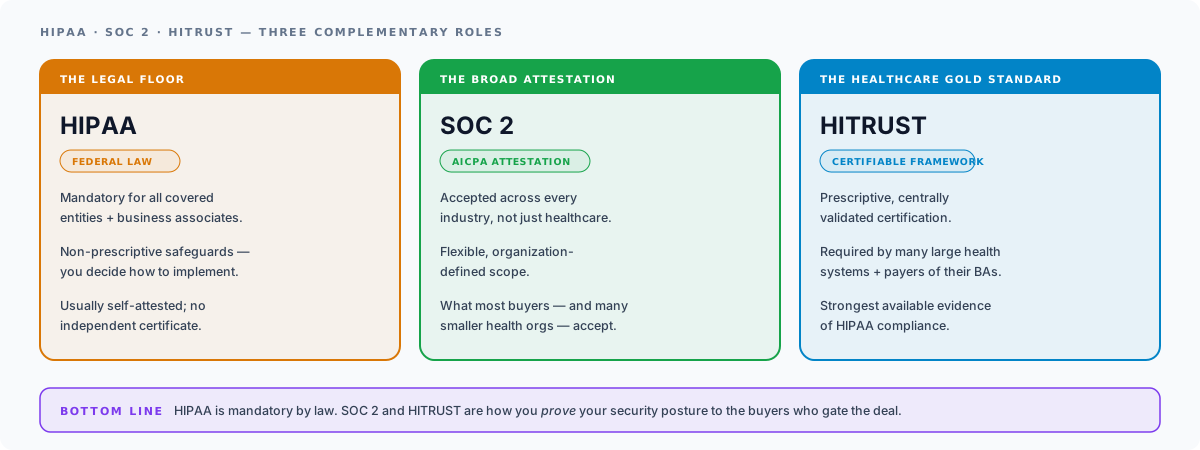
HIPAA is a federal law. The Health Insurance Portability and Accountability Act establishes legal requirements for protecting patient health information. HIPAA’s Security Rule requires covered entities and business associates to implement administrative, physical, and technical safeguards, but it is deliberately non-prescriptive about how to implement them.
HITRUST is a private framework and certification. It was specifically designed to provide a prescriptive, certifiable way to demonstrate compliance with HIPAA (among other regulations). HITRUST CSF maps directly to HIPAA Security Rule requirements and fills in the implementation gaps that HIPAA intentionally leaves open.
Here is the critical distinction: HITRUST certification is not required by HIPAA. There is no legal requirement to pursue HITRUST. However, HITRUST certification is widely regarded as the strongest available evidence of HIPAA compliance. In the event of an OCR audit or a breach investigation, a current HITRUST certification demonstrates that your organization has implemented a comprehensive, independently validated set of controls that map directly to HIPAA requirements.
Many large health systems, health plans, and healthcare clearinghouses now require HITRUST certification from their business associates precisely because it provides this standardized, verifiable evidence of HIPAA compliance. It removes the ambiguity of self-attestation and custom security questionnaires. (If you handle PHI as a business associate, pair this reading with our HIPAA Business Associate Agreement checklist: the BAA is the contract that puts these obligations in writing.)
Head-to-Head Comparison
The following table provides a direct comparison across the dimensions that matter most when evaluating these two frameworks:
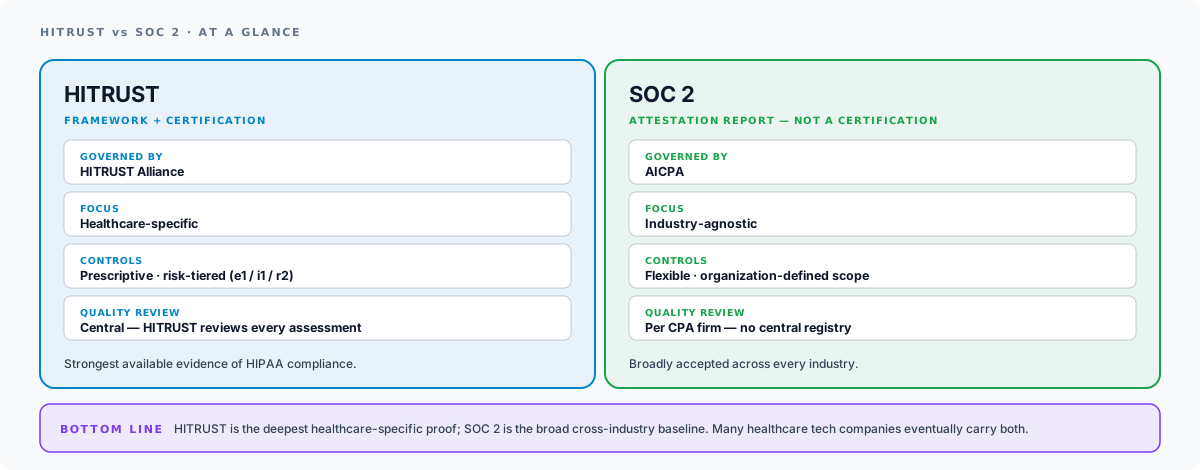
| Dimension | HITRUST | SOC 2 |
|---|---|---|
| Type | Framework + Certification | Audit Report (attestation) |
| Governing body | HITRUST Alliance | AICPA |
| Healthcare-specific | Yes, designed for healthcare | No, industry-agnostic |
| Scope | Prescriptive; controls determined by risk factors | Flexible; organization defines scope and controls |
| Assessment levels | Three tiers: e1, i1, r2 | Two types: Type I, Type II |
| Validity period | e1/i1: 1 year; r2: 2 years | Typically annual (Type II covers 6-12 month period) |
| Controls approach | Prescriptive: specific implementation requirements | Principles-based: organization chooses how to meet criteria |
| Number of controls | 43 (e1) to 2,000+ (r2) | Varies by scope; typically 80-150 controls |
| HIPAA alignment | Direct mapping to HIPAA Security Rule | Can include HIPAA criteria, but not inherent |
| Multi-framework coverage | Maps to 40+ standards (NIST, ISO, PCI, etc.) | Covers SOC 2 TSC only |
| Vendor acceptance (healthcare) | Required by many large health systems and payers | Accepted but often insufficient alone for healthcare |
| Vendor acceptance (general) | Limited recognition outside healthcare | Broadly accepted across industries |
| International recognition | Primarily US healthcare market | Primarily US market (growing internationally) |
| Central quality review | Yes, HITRUST reviews every assessment | No, relies on individual CPA firm quality |
| Maintenance burden | Ongoing MyCSF portal updates, annual monitoring | Annual audit cycle, continuous control monitoring |
Cost and Timeline Deep Dive
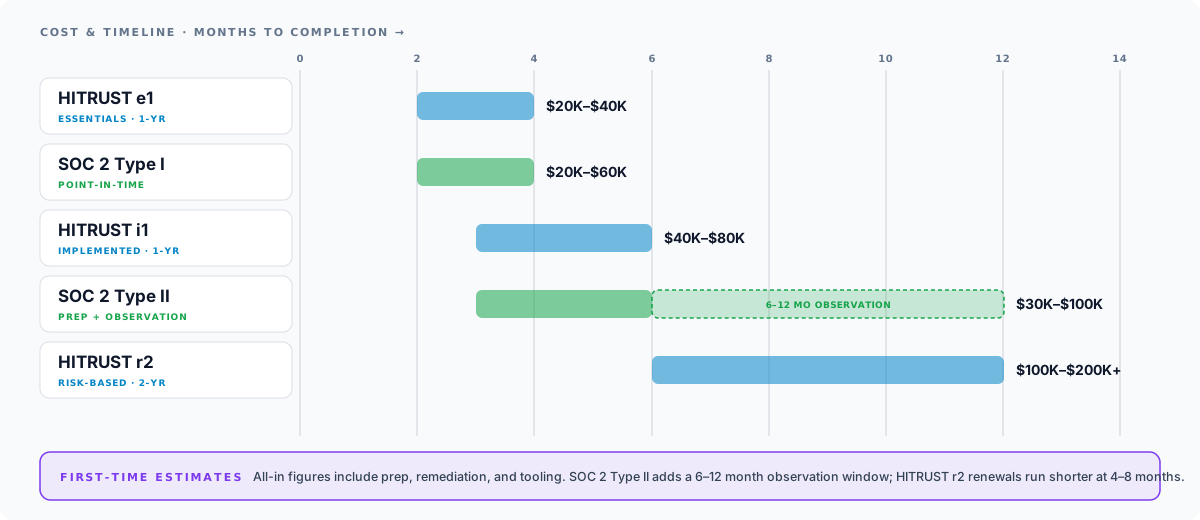
Understanding the true cost of each path requires looking beyond the assessment fees to include preparation, remediation, tooling, and ongoing maintenance.
HITRUST Costs
e1 Assessment:
- External assessor fees: $15,000-$25,000
- Internal preparation and remediation: $5,000-$15,000
- HITRUST MyCSF platform subscription: included in assessor fees
- Total estimated cost: $20,000-$40,000
- Timeline: 2-4 months
i1 Assessment:
- External assessor fees: $25,000-$50,000
- Internal preparation and remediation: $15,000-$30,000
- Gap assessment (recommended): $10,000-$20,000
- Total estimated cost: $40,000-$80,000
- Timeline: 3-6 months
r2 Assessment:
- External assessor fees: $60,000-$120,000
- Internal preparation and remediation: $30,000-$60,000
- Gap/readiness assessment: $15,000-$30,000
- Potential GRC tooling: $10,000-$30,000/year
- Total estimated cost: $100,000-$200,000+
- Timeline: 6-12 months (first time); 4-8 months (renewal)
HITRUST r2 is a significant investment, but it is important to consider the cost relative to the value it provides. A single HITRUST r2 certification can replace dozens of individual customer security assessments, vendor risk questionnaires, and compliance reviews. For organizations with a large healthcare customer base, the certification often pays for itself in reduced compliance overhead.
SOC 2 Costs
Type I:
- External audit fees: $15,000-$40,000
- Internal preparation: $10,000-$25,000
- Readiness assessment (recommended): $5,000-$15,000
- Total estimated cost: $20,000-$60,000
- Timeline: 2-4 months
Type II:
- External audit fees: $25,000-$60,000
- Internal preparation and ongoing monitoring: $10,000-$30,000
- Compliance automation tooling (optional but common): $10,000-$30,000/year
- Total estimated cost: $30,000-$100,000
- Timeline: 3-6 months for preparation + 6-12 month observation period
Recurring Costs
Both frameworks require ongoing investment. HITRUST i1 and e1 require annual reassessment. HITRUST r2 requires an interim assessment at the one-year mark and full reassessment every two years. SOC 2 Type II requires a new audit annually, covering the most recent observation period.
Factor in the internal staff time for evidence collection, control monitoring, policy updates, and auditor coordination. For most mid-size organizations, this translates to at least one dedicated compliance resource, whether that is a full-time hire or a fractional compliance manager.
When to Choose HITRUST
HITRUST is the right choice when your organization meets one or more of the following criteria:
Your customers require it. This is the most straightforward reason. If the health systems, health plans, or healthcare organizations you serve require HITRUST certification from their vendors, the decision is already made. Check your customer contracts, vendor risk assessments, and RFP requirements.
You handle PHI as a business associate. Organizations that store, process, or transmit protected health information on behalf of covered entities benefit most from HITRUST. The framework was built for exactly this use case, and the certification provides the strongest available evidence of HIPAA compliance.
You want to reduce questionnaire fatigue. If your sales and compliance teams spend significant time responding to custom security questionnaires from healthcare customers, a HITRUST certification can dramatically reduce that burden. Many health systems accept a current HITRUST certification in lieu of their standard vendor risk assessment process.
You need multi-framework coverage. If you are subject to multiple regulatory requirements (HIPAA, NIST, state privacy laws, PCI DSS), HITRUST’s mapping to 40+ standards means a single certification effort addresses multiple compliance obligations simultaneously.
You want prescriptive guidance. If your organization is building a security program from the ground up, HITRUST’s prescriptive controls provide a detailed roadmap for what to implement and how to implement it. This is valuable for organizations that lack a large internal security team.
When to Choose SOC 2
SOC 2 is the right choice in these scenarios:
You serve multiple industries. If healthcare is one of several verticals you serve, SOC 2 provides a universally recognized proof of security that works across industries. A SOC 2 Type II report is accepted by financial services, technology, retail, and healthcare organizations alike.
Cost is a primary constraint. For organizations with limited compliance budgets, SOC 2 Type II provides meaningful security assurance at a lower cost than HITRUST r2. If your healthcare customers accept SOC 2 (verify this before assuming), it can be the more efficient path.
You want scope flexibility. SOC 2 allows you to define the scope of your audit precisely. If you want to limit the assessment to a specific product, system, or service, SOC 2 gives you that control. HITRUST scoping is also customizable, but the prescriptive control requirements are more extensive.
Your customers accept it. Some healthcare organizations, particularly smaller practices, digital health startups, and non-enterprise customers, accept SOC 2 Type II reports without requiring HITRUST. Survey your customer base to understand their actual requirements before committing to a path.
You need a report quickly. SOC 2 Type I can be completed in two to four months, providing an interim proof of security while you build toward either a SOC 2 Type II or HITRUST certification. This can be valuable for closing deals with compliance-sensitive customers while your longer-term certification is in progress.
Can You Get Both?
Yes, and many organizations do. Pursuing both HITRUST and SOC 2 is not uncommon, particularly for healthcare technology companies that serve both enterprise health systems (which often require HITRUST) and smaller organizations or non-healthcare customers (which accept SOC 2).
The Overlap Advantage
There is significant control overlap between HITRUST and SOC 2. If you have already implemented controls for one framework, you have a substantial head start on the other. HITRUST’s prescriptive controls generally satisfy or exceed the requirements for SOC 2’s Trust Service Criteria. Going from HITRUST to SOC 2 is typically easier than the reverse.
Combined Assessments
Some assessment firms offer combined HITRUST and SOC 2 engagements, where a single assessment process produces both a HITRUST certification and a SOC 2 Type II report. This approach reduces the total cost and timeline compared to running two completely separate assessments. Ask your assessor about combined engagement options.
A Phased Approach
A common and practical strategy for organizations that need both but have budget constraints:
-
Year 1: Achieve SOC 2 Type II. This establishes your baseline security program, gives you an externally validated report, and satisfies customers who accept SOC 2.
-
Year 2: Pursue HITRUST i1 or r2, building on the controls and processes you established for SOC 2. The gap between a mature SOC 2 program and HITRUST readiness is smaller than starting HITRUST from scratch.
-
Year 3+: Maintain both on their respective renewal cycles. Many organizations eventually consolidate around HITRUST r2 if their customer base is predominantly healthcare, since it provides the strongest assurance and can reduce the need for the separate SOC 2 report.
Decision Framework
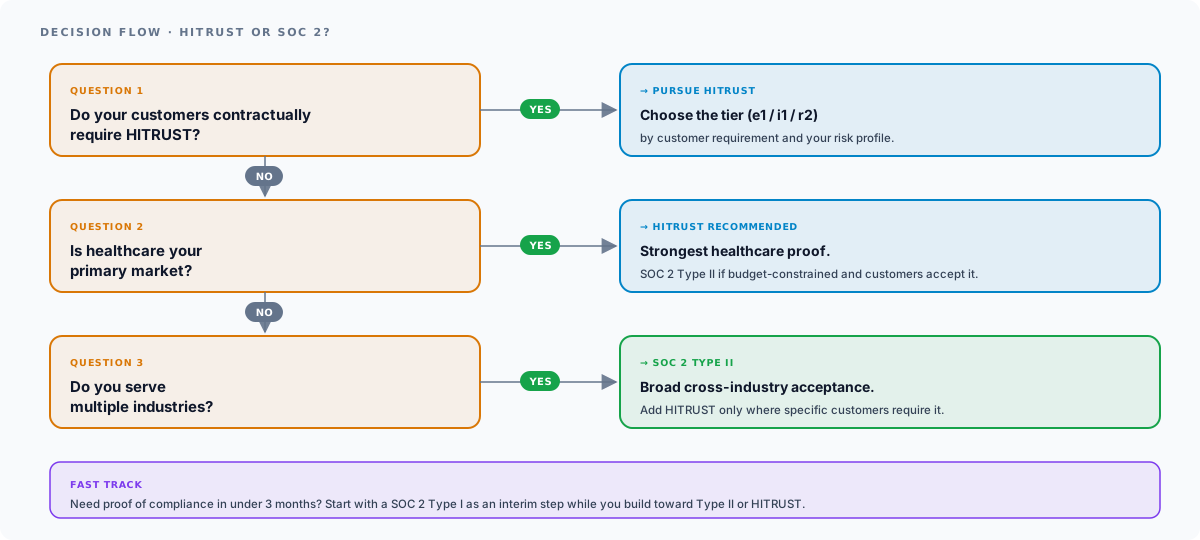
Use the following questions to guide your decision:
Step 1: What Do Your Customers Require?
Survey your top 10 customers and your sales pipeline. If the majority require HITRUST specifically, that is your answer. If they accept SOC 2, you have more flexibility. If you are not sure, ask their compliance or vendor risk management teams directly.
Step 2: What Is Your Industry Focus?
- Primarily healthcare: Lean toward HITRUST. It provides the most comprehensive coverage for healthcare-specific requirements and carries the most weight with healthcare customers.
- Healthcare plus other industries: Consider both, starting with SOC 2 for broader coverage and adding HITRUST for healthcare-specific customers.
- Healthcare is a small segment: SOC 2 is likely sufficient. Add HITRUST only if specific customers require it.
Step 3: What Is Your Budget?
- Under $50,000: SOC 2 Type II or HITRUST e1/i1. You can achieve meaningful compliance assurance at this level.
- $50,000-$150,000: SOC 2 Type II with HITRUST i1, or HITRUST r2 alone if healthcare is your primary market.
- $150,000+: HITRUST r2, potentially with a combined SOC 2 assessment.
Step 4: What Is Your Timeline?
- Need proof of compliance in under 3 months: SOC 2 Type I as an interim step.
- 3-6 months: SOC 2 Type II (if you have mature controls) or HITRUST e1/i1.
- 6-12 months: HITRUST r2 or a combined HITRUST + SOC 2 assessment.
Step 5: What Existing Compliance Work Have You Done?
If you have already completed an ISO 27001 certification, NIST CSF assessment, or other security framework implementation, you have a head start on both paths. Map your existing controls to HITRUST and SOC 2 requirements to identify gaps and estimate the incremental effort.
Implementation Checklist
Regardless of which path you choose, the following steps will set you up for success:
- Inventory all systems that store, process, or transmit sensitive data (especially PHI)
- Document your current security controls and policies
- Conduct a gap assessment against your target framework
- Assign a compliance project owner with clear authority and budget
- Select an experienced assessor or auditor (check references with healthcare clients)
- Build a remediation roadmap with realistic timelines
- Implement a GRC or compliance automation platform to streamline evidence collection
- Conduct internal training on control requirements and evidence standards
- Perform a readiness assessment before the formal assessment
- Plan for ongoing maintenance from day one, not as an afterthought
How Saga IT Can Help
Navigating the compliance landscape for healthcare security certifications requires deep expertise in both the technical controls and the assessment process. Saga IT brings hands-on experience across HITRUST, SOC 2, and HIPAA compliance programs. Our team can help you:
- Assess your current state with a gap analysis against HITRUST CSF, SOC 2 TSC, or both
- Build a compliance roadmap that aligns with your budget, timeline, and customer requirements
- Implement technical controls across cloud infrastructure, application security, and data protection
- Prepare for assessment with readiness reviews, evidence collection support, and mock assessments
- Design ongoing compliance programs that integrate security into your development and operations processes
Whether you are pursuing your first certification or optimizing an existing compliance program, we can help you make an informed decision and execute efficiently.
Learn more about our healthcare compliance consulting services or explore our broader healthcare security, HIPAA compliance, and cybersecurity capabilities. If your buyers are international as well as US-based, see how SOC 2 stacks up against the international ISO 27001 standard in our companion ISO 27001 vs SOC 2 comparison.
Contact Saga IT to discuss your compliance strategy and get started on the right path.