Introduction
ISO 27001 and SOC 2 are the two most widely recognized information security frameworks in the world. For healthcare organizations, both can serve as pillars of a compliance program that demonstrates security maturity to customers, regulators, and partners. But they are not interchangeable. They differ in governance, structure, geographic recognition, cost, and their relationship to healthcare-specific requirements like HIPAA.
Choosing the right framework, or deciding to pursue both, depends on your organization’s geography, customer base, growth strategy, and existing compliance infrastructure. This guide provides a detailed, practical comparison to help healthcare IT leaders make that decision with confidence.
If you are also evaluating HITRUST, which is the most healthcare-specific option, see our companion post on HITRUST vs SOC 2.
What Is ISO 27001?
ISO/IEC 27001 is an international standard for establishing, implementing, maintaining, and continually improving an Information Security Management System (ISMS). It is published jointly by the International Organization for Standardization (ISO) and the International Electrotechnical Commission (IEC). The current version is ISO/IEC 27001:2022, which replaced the 2013 edition. The transition window closed on 31 October 2025. 2013-version certificates are no longer valid, so any new or maintained certification today is necessarily against the 2022 revision.
The ISMS Approach
What distinguishes ISO 27001 from most other security frameworks is its emphasis on the management system itself, not just individual controls. An ISMS is a systematic approach to managing sensitive information so that it remains secure. It encompasses people, processes, and technology, and it requires a structured risk management methodology.
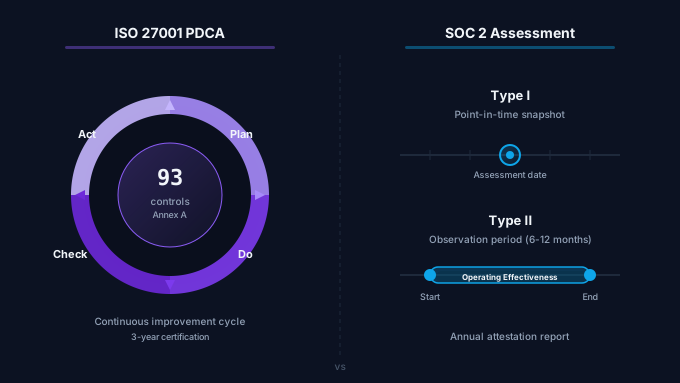
The standard follows the Plan-Do-Check-Act (PDCA) cycle:
- Plan: Establish the ISMS scope, conduct risk assessments, select controls, and define the Statement of Applicability.
- Do: Implement the controls and processes defined in the planning phase.
- Check: Monitor, measure, and audit the ISMS to evaluate performance against objectives.
- Act: Take corrective actions based on audit findings and management reviews. Continually improve the ISMS.
This cyclical approach means ISO 27001 is not a one-time effort. It demands ongoing governance, regular internal audits, management reviews, and documented continuous improvement. Organizations that treat it as a checkbox exercise will struggle to maintain certification.
Annex A Controls
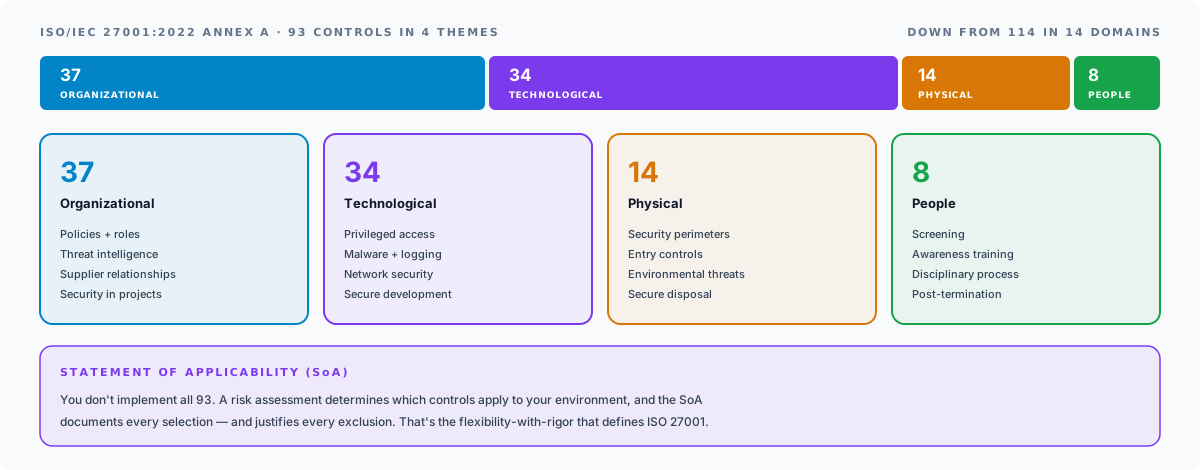
ISO 27001:2022 includes 93 controls organized into four categories in Annex A:
- Organizational controls (37): Policies, roles and responsibilities, threat intelligence, information security in project management, supplier relationships, and more.
- People controls (8): Screening, terms and conditions of employment, information security awareness and training, disciplinary processes, and responsibilities after termination.
- Physical controls (14): Physical security perimeters, physical entry controls, securing offices and facilities, protection against environmental threats, equipment maintenance, and secure disposal.
- Technological controls (34): User endpoint devices, privileged access, information access restriction, secure authentication, capacity management, malware protection, logging, network security, secure development lifecycle, and data masking.
Organizations are not required to implement every Annex A control. Instead, they conduct a risk assessment, determine which controls are applicable to their environment and risk profile, and document their selections in a Statement of Applicability (SoA). This provides flexibility while maintaining rigor through the requirement to justify any exclusions.
Certification Process
ISO 27001 certification is performed by accredited certification bodies (CBs), which are organizations accredited by national accreditation bodies (such as ANAB in the US or UKAS in the UK). The certification audit has two stages:
Stage 1 (Documentation Review): The auditor reviews your ISMS documentation, including policies, risk assessment, Statement of Applicability, and procedures. This stage confirms that the ISMS is designed to meet the standard’s requirements and identifies any areas that need attention before Stage 2.
Stage 2 (Implementation Audit): The auditor conducts an on-site (or remote) assessment to verify that the ISMS is implemented and operating effectively. This includes interviewing staff, reviewing evidence of control operation, and testing processes.
After successful completion of both stages, the certification body issues a certificate valid for three years. During that three-year cycle, the organization undergoes annual surveillance audits (typically shorter and focused on specific areas) to maintain certification. At the end of three years, a full recertification audit is required.
What Is SOC 2?
SOC 2 is an audit framework developed by the AICPA that produces an attestation report on an organization’s controls related to one or more Trust Service Criteria. For a detailed overview of SOC 2 including the five Trust Service Criteria and how the framework operates, see our HITRUST vs SOC 2 comparison.
The key points relevant to this comparison:
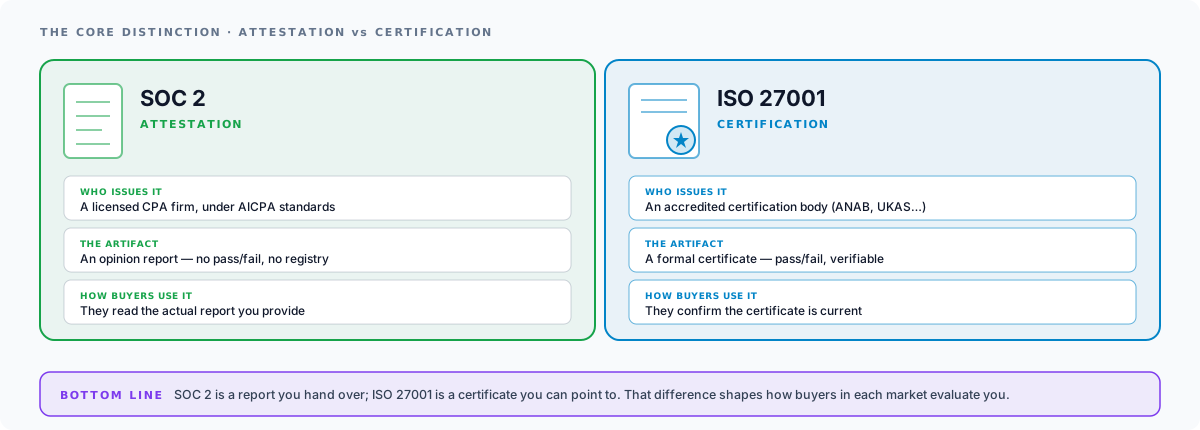
- SOC 2 is governed by the AICPA and is performed by licensed CPA firms
- It evaluates controls against five Trust Service Criteria: Security (required), Availability, Processing Integrity, Confidentiality, and Privacy
- SOC 2 produces an audit report (attestation), not a certification
- Organizations have significant flexibility in defining scope, selecting controls, and choosing which Trust Service Criteria to include
- SOC 2 is primarily recognized in the US market but is gaining international traction
Head-to-Head Comparison
This table provides a comprehensive comparison across the dimensions most relevant to healthcare organizations:
| Dimension | ISO 27001 | SOC 2 |
|---|---|---|
| Governing body | ISO/IEC (international standards body) | AICPA (US accounting profession) |
| Type | International standard + Certification | Audit framework + Attestation report |
| Global recognition | Strong worldwide, dominant in EU, APAC, Middle East | Primarily US; growing in UK, Canada, Australia |
| US market recognition | Growing but secondary to SOC 2 among US customers | Dominant in US market |
| Healthcare-specific | No (but extensible via ISO 27799) | No (but can include HIPAA criteria) |
| Certification vs Report | Formal certification by accredited body | Attestation report by CPA firm |
| Validity period | 3 years (with annual surveillance audits) | Annual (Type II covers 6-12 month period) |
| Initial cost | $50,000-$150,000 | $30,000-$100,000 |
| Annual maintenance cost | $15,000-$40,000 (surveillance audits) | $30,000-$100,000 (full annual audit) |
| Timeline to achieve | 6-12 months | 3-6 months (Type II requires observation period) |
| Scope definition | Risk-based; Statement of Applicability | Organization-defined; system boundaries |
| Controls structure | 93 Annex A controls in 4 categories | Criteria-based; organization selects controls |
| Risk assessment | Formal risk assessment methodology required | Risk considerations but no specific methodology required |
| Continuous improvement | Explicitly required (PDCA cycle, management review) | Not explicitly required (but good practice) |
| Internal audit requirement | Required (at least annually) | Not required by the framework |
| Management review | Required (documented, at planned intervals) | Not required by the framework |
| Audit frequency | Annual surveillance + triennial recertification | Annual Type II audit |
| HIPAA alignment | Indirect; requires additional healthcare-specific controls | Indirect; can add HIPAA criteria to scope |
| Integration with other ISO standards | Native integration with ISO 9001, ISO 27701, ISO 27799 | Standalone framework |
| Automation and tooling | Supported by most GRC platforms | Supported by most compliance automation platforms |
Geographic Considerations
Geography is one of the most significant factors in choosing between ISO 27001 and SOC 2. Their market recognition varies dramatically by region.
Where ISO 27001 Dominates
European Union: ISO 27001 is the default security certification across the EU. European procurement teams, regulators, and partners expect it. Its alignment with GDPR principles makes it the natural choice for organizations selling to EU markets. Many EU government contracts and healthcare tenders require ISO 27001 certification.
Asia-Pacific: ISO 27001 is the dominant security standard across APAC markets including Japan, South Korea, Australia, India, and Singapore. In Japan, it is so prevalent that many organizations view it as a baseline requirement rather than a differentiator.
Middle East and Africa: Countries with growing healthcare technology sectors, such as the UAE and Saudi Arabia, increasingly require ISO 27001 from vendors.
Where SOC 2 Dominates
United States: SOC 2 is the dominant security attestation framework in the US market. When US-based customers, investors, or partners ask “Do you have a security certification?”, they are usually referring to SOC 2. The healthcare sector is no exception: while HITRUST is preferred for healthcare-specific assurance, SOC 2 remains the most commonly requested general security attestation from US healthcare organizations.
Canada: SOC 2 has strong recognition in Canada due to the close economic relationship with the US. Canadian organizations serving US customers almost always need SOC 2.
Strategic Implications for Healthcare Organizations
US healthcare organizations selling internationally: If you plan to expand into European, APAC, or Middle Eastern healthcare markets, ISO 27001 is effectively a prerequisite. A SOC 2 report may be unfamiliar to procurement and compliance teams in these regions.
International organizations selling into US healthcare: You need SOC 2 to be taken seriously by US healthcare customers. Your ISO 27001 certification, while respected, will not typically satisfy their vendor risk assessment requirements.
US-only healthcare organizations: SOC 2 is likely sufficient for general security attestation. Consider ISO 27001 only if you want a more structured ISMS approach or if specific customers require it.
Cost Comparison
Understanding the total cost of ownership requires looking beyond audit fees to include preparation, implementation, tooling, and ongoing maintenance.
ISO 27001 Costs
Initial Certification (Year 1):
- ISMS development and documentation: $15,000-$40,000 (internal staff time or consultant support)
- Risk assessment and gap analysis: $10,000-$25,000
- Control implementation and remediation: $10,000-$40,000 (varies significantly based on existing maturity)
- Internal audit: $5,000-$15,000 (internal resources or outsourced)
- Certification audit (Stage 1 + Stage 2): $15,000-$40,000
- GRC platform or documentation tooling: $5,000-$20,000/year
- Total Year 1 estimated cost: $50,000-$150,000
Ongoing Annual Costs (Years 2-3):
- Surveillance audit: $8,000-$20,000
- Internal audit: $5,000-$15,000
- ISMS maintenance (policy updates, risk reviews, management reviews): $5,000-$15,000
- GRC platform: $5,000-$20,000/year
- Total annual maintenance: $15,000-$40,000
Recertification (Year 4):
- Full recertification audit: $12,000-$35,000
- ISMS refresh and update: $5,000-$15,000
- Recertification cost: $17,000-$50,000
SOC 2 Costs
Initial Audit (Year 1):
- Readiness assessment: $5,000-$15,000
- Control implementation and documentation: $10,000-$30,000
- Type I audit (optional interim step): $15,000-$40,000
- Type II audit: $25,000-$60,000
- Compliance automation platform: $10,000-$30,000/year
- Total Year 1 estimated cost: $30,000-$100,000 (Type II only; add $15,000-$40,000 if you also do a Type I)
Ongoing Annual Costs:
- Type II audit: $25,000-$60,000
- Compliance automation platform: $10,000-$30,000/year
- Internal preparation and evidence collection: $5,000-$15,000
- Total annual maintenance: $30,000-$100,000
Total Cost of Ownership Over Three Years
| ISO 27001 | SOC 2 Type II | |
|---|---|---|
| Year 1 | $50,000-$150,000 | $30,000-$100,000 |
| Year 2 | $15,000-$40,000 | $30,000-$100,000 |
| Year 3 | $15,000-$40,000 | $30,000-$100,000 |
| 3-Year Total | $80,000-$230,000 | $90,000-$300,000 |
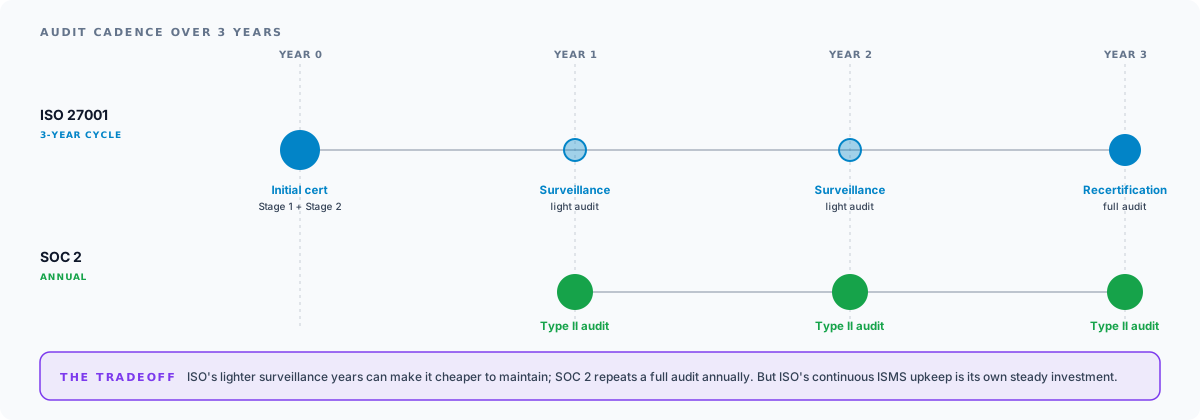
While ISO 27001 has a higher upfront cost, its three-year certification cycle with lighter surveillance audits can make it more cost-effective over time compared to SOC 2’s full annual audit requirement. However, ISO 27001’s ongoing ISMS maintenance requires steady internal investment not always reflected in external audit fees.
Healthcare-Specific Considerations
Neither ISO 27001 nor SOC 2 was designed specifically for healthcare. Both are industry-agnostic frameworks. This is a significant consideration for healthcare organizations that must comply with HIPAA and demonstrate that compliance to partners and regulators.
ISO 27001 and Healthcare
ISO 27001 can be extended with ISO 27799, a companion standard that provides healthcare-specific implementation guidance for the Annex A controls. It addresses topics like protecting health information in clinical workflows, managing access to electronic health records, and addressing healthcare-specific threats such as medical device security. However, ISO 27799 is not widely adopted in the US market. US healthcare organizations using ISO 27001 will typically need to supplement it with explicit HIPAA controls and documentation.
SOC 2 and Healthcare
SOC 2 can be customized by including the Privacy Trust Service Criteria, adding HIPAA criteria as additional subject matter (often called a SOC 2 + HIPAA report), and scoping the audit to cover systems that process PHI. A SOC 2 + HIPAA report evaluates controls against both Trust Service Criteria and HIPAA Security Rule requirements, providing broader assurance without requiring a separate HIPAA audit. Many healthcare technology companies find this to be a practical middle ground, and it feeds directly into the vendor due diligence and BAA obligations that covered entities require of their business associates.
The HITRUST Alternative
For organizations where healthcare is the primary market, HITRUST CSF provides the most comprehensive, healthcare-specific framework. HITRUST incorporates and maps to both ISO 27001 and SOC 2 requirements (among 40+ other standards), making it a single-framework solution for healthcare compliance. See our HITRUST vs SOC 2 comparison for a detailed analysis.
SOC 2 Type 1 vs Type 2: A Detailed Comparison
Since both ISO 27001 and SOC 2 Type II assessments require demonstrated operational effectiveness, it is worth understanding how SOC 2’s two report types map onto ISO’s audit model. (For the full SOC 2 fundamentals, the five Trust Service Criteria and how the framework operates, see the HITRUST vs SOC 2 comparison; here we focus on the ISO 27001 parallel.)
SOC 2 Type 1
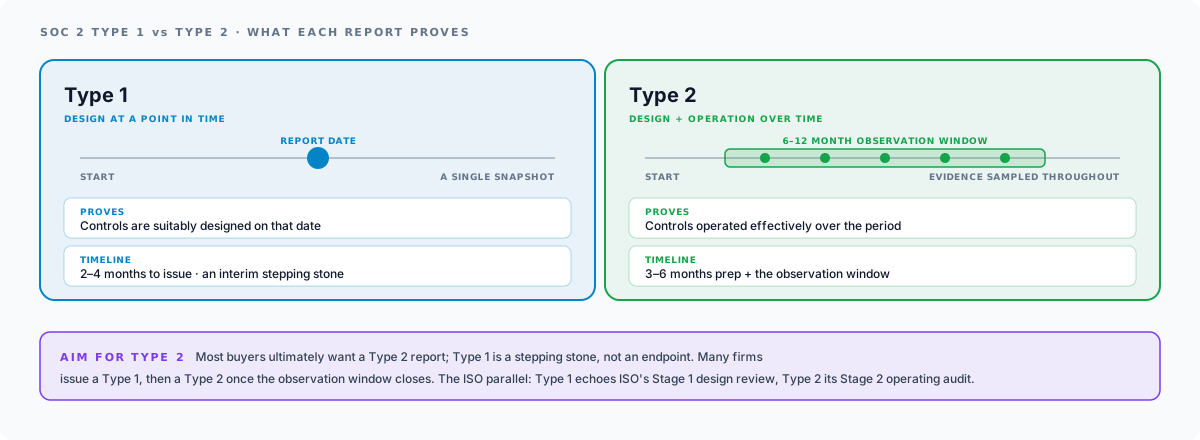
A Type 1 report evaluates the design of controls at a specific point in time. The auditor examines your control environment on a particular date and provides an opinion on whether the controls are suitably designed to meet the selected Trust Service Criteria.
What it proves: Your controls are designed correctly as of the report date.
What it does not prove: That the controls actually work consistently over time.
Typical use cases:
- Organizations pursuing SOC 2 for the first time and needing an interim report while building a track record for Type 2
- Satisfying a customer requirement quickly while a Type 2 observation period is underway
- Newly launched products or services that do not yet have six months of operational history
Timeline: 2-4 months from kickoff to report issuance.
SOC 2 Type 2
A Type 2 report evaluates both the design and operating effectiveness of controls over a defined observation period, typically six to twelve months. The auditor tests controls throughout the period, examines samples of evidence, and provides an opinion on whether the controls operated effectively.
What it proves: Your controls are designed correctly and have worked consistently over the observation period.
Typical use cases:
- Ongoing annual compliance attestation
- Satisfying sophisticated customer and partner requirements
- Demonstrating operational security maturity to investors and prospects
Timeline: 3-6 months of preparation + 6-12 month observation period.
Which Type Should You Pursue?
Start with Type 2 as your goal. Most customers who care about SOC 2 ultimately want a Type 2 report. A Type 1 is acceptable as a stepping stone, but should not be your endpoint. Many organizations complete a Type 1 while simultaneously beginning their Type 2 observation period, resulting in a Type 2 report six to twelve months after their initial Type 1.
If you are comparing SOC 2 Type 2 to ISO 27001, note that both assess operating effectiveness over time. ISO 27001’s Stage 2 audit evaluates implementation and operation of the ISMS, conceptually similar to SOC 2 Type 2. The key differences are in scope, methodology, and ongoing maintenance requirements.
Pursuing Both ISO 27001 and SOC 2
Many enterprise healthcare organizations maintain both ISO 27001 and SOC 2. This is not redundant; the two frameworks serve different audiences and provide complementary value.
The Complementary Model
ISO 27001 provides the foundation. The ISMS establishes your organization’s governance framework, risk management methodology, and continuous improvement processes. It forces you to build a mature, systematic approach to security that extends beyond any single audit.
SOC 2 provides the proof. A SOC 2 Type II report is the format that US customers expect for vendor due diligence. It translates your security posture into a document that procurement, legal, and compliance teams know how to evaluate.
Control Mapping and Efficiency
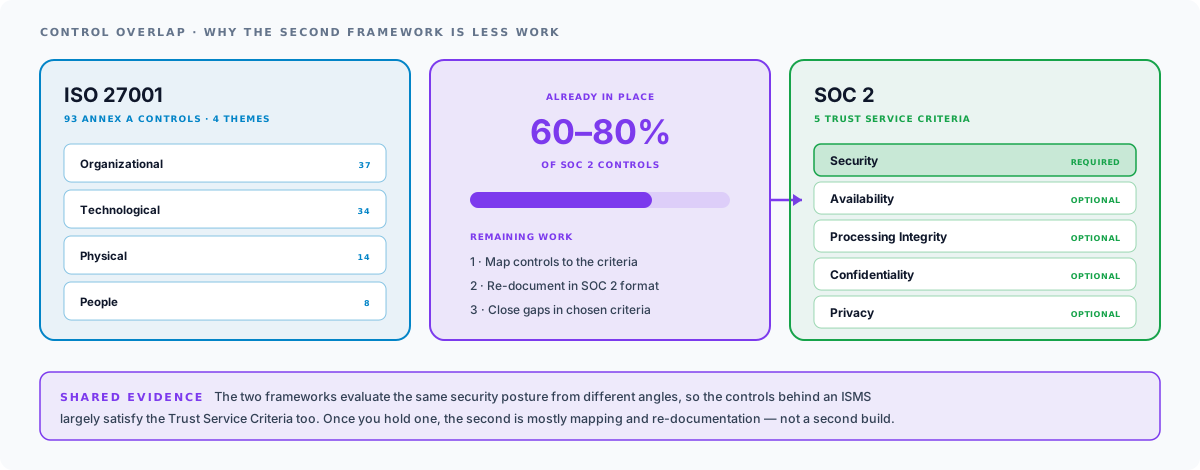
There is substantial overlap between ISO 27001 Annex A controls and SOC 2 Trust Service Criteria. Organizations that have implemented ISO 27001 will find that 60-80% of the controls required for SOC 2 are already in place. The additional effort for SOC 2 typically involves mapping existing controls to Trust Service Criteria, documenting controls in the SOC 2 format, and addressing any gaps in your selected criteria.
Practical Implementation Strategy
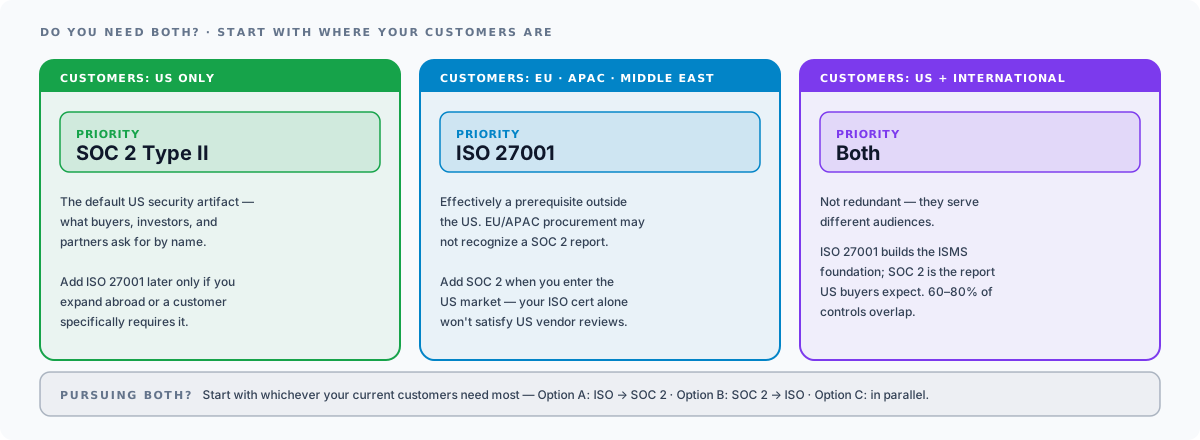
Option A: ISO 27001 first, then SOC 2. Build the strongest foundation first. Establish a comprehensive ISMS, then layer SOC 2 on top using existing controls and documentation. Ideal for organizations that value long-term security maturity and have the budget for ISO 27001’s more extensive initial implementation.
Option B: SOC 2 first, then ISO 27001. Get to market faster. SOC 2 Type II can typically be achieved more quickly and at lower initial cost. Once stable, formalize your program into an ISMS and pursue ISO 27001. Practical for organizations that need US market credibility immediately but plan to expand internationally.
Option C: Simultaneous implementation. Implement both in parallel using a GRC platform to manage controls that satisfy both standards. Efficient but requires more resources upfront, best suited for organizations with experienced compliance teams.
Decision Framework
Use these questions to determine the right path for your organization, or start with a gap assessment against either framework if you would rather measure your current state first:
Question 1: Where Are Your Customers?
- Primarily US: SOC 2 Type II is the priority. Add ISO 27001 later if needed for international expansion.
- Primarily international (EU, APAC): ISO 27001 is the priority. Add SOC 2 if you enter the US market.
- Both US and international: Pursue both. Start with whichever is more urgently needed by your current customer base.
Question 2: What Do Your Contracts Require?
Review your customer contracts, vendor risk assessments, and RFP requirements. If specific frameworks are named, those are your requirements. If contracts are vague (“industry-standard security certification”), ISO 27001 or SOC 2 Type II will both satisfy the requirement in most cases.
Question 3: What Is Your Growth Strategy?
- Expanding internationally: ISO 27001 opens doors that SOC 2 cannot. European healthcare procurement teams may not accept a SOC 2 report.
- Deepening US healthcare presence: SOC 2 with HIPAA criteria, or HITRUST for maximum healthcare-specific assurance.
- Pursuing government contracts: ISO 27001 is often preferred, particularly for international government healthcare programs. US federal healthcare may require FedRAMP or NIST 800-53, which ISO 27001 maps to but does not replace.
Question 4: What Compliance Infrastructure Do You Have?
- Mature security program with documented policies: You are likely closer to ISO 27001 readiness than you think. A gap assessment will clarify the effort.
- Ad-hoc security practices: SOC 2 may be easier to achieve first because of its more flexible scope. Use it to build the discipline, then formalize into an ISMS for ISO 27001.
- Existing ISO 9001 or other ISO certifications: ISO 27001 integrates natively with other ISO management system standards, reducing the incremental effort significantly.
Question 5: What Is Your Budget?
- Under $50,000: SOC 2 Type II is the most achievable option at this budget level.
- $50,000-$100,000: Either SOC 2 Type II (with compliance automation) or ISO 27001 initial certification for a smaller scope.
- $100,000+: Both frameworks are achievable, either sequentially or in parallel.
Implementation Checklist
Whether you choose ISO 27001, SOC 2, or both, these steps will prepare your organization:
- Define your scope: which systems, data, and processes are included
- Conduct a formal risk assessment to identify threats, vulnerabilities, and controls
- Document your security policies, standards, and procedures
- Implement technical controls (access management, encryption, logging, monitoring)
- Establish an incident response plan and test it
- Train all employees on security awareness and their specific responsibilities
- Select and implement a GRC or compliance automation platform
- Conduct a gap assessment against your target framework
- Perform an internal audit (required for ISO 27001, recommended for SOC 2)
- Select an auditor or certification body with healthcare experience
- Build an evidence library with systematic control documentation
- Plan for ongoing maintenance: schedule recurring reviews, audits, and updates
How Saga IT Can Help
Implementing ISO 27001, SOC 2, or both requires expertise that spans information security governance, technical control implementation, and audit preparation. Saga IT works with healthcare organizations at every stage of the compliance journey:
- Readiness assessments that identify gaps against ISO 27001 Annex A controls, SOC 2 Trust Service Criteria, or both frameworks simultaneously
- ISMS development for ISO 27001, including risk assessment methodology, Statement of Applicability, and policy documentation
- Control implementation across cloud infrastructure (AWS, Azure, GCP), application security, and data protection
- HIPAA integration to ensure your ISO 27001 or SOC 2 program addresses healthcare-specific regulatory requirements
- Audit preparation with evidence collection support, internal audit execution, and mock assessments
- Ongoing compliance management to maintain certifications and reduce the burden of annual audits
Our team understands the unique challenges of healthcare compliance, from PHI handling requirements to the complex vendor relationships that characterize the healthcare technology ecosystem.
Learn more about our healthcare compliance consulting services or explore our HIPAA compliance and technical security controls capabilities. For a comparison that includes HITRUST, the most healthcare-specific certification option, read our guide on HITRUST vs SOC 2: Which Certification Does Your Healthcare Organization Need?.
Contact Saga IT to discuss your compliance strategy and determine the right framework for your organization.